2015 Gantry Plaza State Park Water Quality

sampling2

2015 Citizen Water Quality Testing Program Report

by Josue Silvestre, Engineer in Training
HarborLAB Water Quality Sampling Coordinator

HarborLAB takes part in the Citizen Water Quality Testing Program (CWQTP), an initiative of the New York City Water Trail Association that coordinates weekly grassroots monitoring of metropolitan area waterways for a 20-week period from May through October. I had the opportunity to lead HarborLAB’s participation in 2015. Our focus was again Gantry Plaza State Park, where we serve cumulatively thousands of children, teens, and adults through public paddling programs and special partnerships with organizations serving disadvantaged youth.

We received training from The River Project and a research team at Columbia University’s Earth Institute on water sampling at docks and shorelines. The sampling season launched on May 28 with 38 sites from Yonkers to Jamaica Bay. We measured nitrate and phosphate with in-situ testing kits and brought chilled samples rapidly to five labs to test for Enterococcus, a gut bacterium indicative of sewage. While nitrate and phosphate levels are immediately registered, bacteria must be incubated for more than 24 hours.

Gantry Plaza State Park is on the East River, a tidal strait within the Hudson River Estuary. The CWQTP concerns itself with wastewater contamination of the East River due to past and recurring contamination from combined sewer outfalls (CSO) and malfunctioning of wastewater treatment facilities. Paddling groups and nonprofit littoral ecology experts assert that because NYC Department of Environmental Protection surveys sample in deeper water, official statistics don’t account for bacterial colonies near shore, where human contact and wildlife activity is greatest. NYC Department of Health water testing focuses on swimming beaches, not kayak and canoe launches.

HarborLAB cancels programming at Gantry Plaza State Park on days following significant rain as a precaution against CSO contamination.

Enterococcus levels are presented as a Most Probable Number (MPN), or the number of colonies per 100 ml of water counted after incubation. These numbers set thresholds for recommending public notifications or temporary closures. New York City Department of Health Enterococcus standards for swimming are as follows:

MPN <35 = acceptable for swimming

MPN between 35 and 104 = unacceptable if level persist

MPN >104 = unacceptable for swimming

Throughout the 2015 CWQTP season (see figure 1) lab results showed that the presence of Enterococcus at Gantry Plaza State Park usually measured within acceptable conditions for swimming. It was observed that on three occasions Enterococcus levels at the site were unacceptable for swimming. Similar results were obtained in the previous 2014 CWQTP season (see figure 2) with one measurement exceeding the limit acceptable for swimming.

These spikes might correlate to rainfall prior to measurement (with one of the three a possibly anomalous result), as seen in figure 3, provided by the Riverkeeper organization through the citizen testing data web tool hosted on its website. That is, a wetter season in 2015 may be the cause for having have three peaks in Enterococcus counts compared to one peak in 2014. The amount of rainfall in the 2014 season, from May 22 to October 02, was 14.76 inches, according to the National Weather Service Forecast Office. That was 1.59 inches less than the 2015 season’s 16.35 inches for a same period (May 21-October 01).

Nitrate (NO3) and Phosphate (PO4) in-situ testing was new to the 2015 season. Nitrates and phosphates from urban runoff can cause eutrophication, a process that depletes lakes, streams, and rivers of oxygen. The procedure for in-situ testing was straight forward. The test kit consisted of two small tubes with nitrate and phosphate reactors and a small cube (see figure 4). Each tube would absorb water from a small cube of the sampled water. The tubes would change color after a few minutes indicating the level of NO3 or PO4 respectively. Throughout the season, low concentrations of Nitrate and Phosphate testing were recorded and these remained constant.

For me, as an international student with an engineering background in water resources, and an advocate of sustainable water management, constant monitoring of water bodies is of utmost relevance. It informs environmental regulators whether the water body supports a healthy aquatic ecosystem. While participating with HarborLAB collecting water samples, I came to appreciate the importance of keeping New York City’s waterways pollutant free. It helps revitalize shores once plentiful with aquatic life and maintain a balance in the ecosystem. In addition to revitalizing shores, effectively protecting our water bodies from pollutants creates an increased public interest in recreational water activities.

2015ent

Fig. 1 2015 CWQT Season Enterococcus test results

ent2014

Fig. 2 2014 CWQT Season Enterococcus test results

entrain

Fig.3 Enterococcus count and rainfall correlation. (Extracted from Riverkeeper.org/water-quality/citizen-data.)


nitratetest

Fig. 4 Nitrates and Phosphates in-situ testing kit


Neversink Reservoir Fleet Arrives!

Neversink Reservoir Fleet received by Forst Valley YMCA and funded by Catskill Watershed Corporation with support from NYC Department of Environmental Protection.

Neversink Reservoir Fleet received by Frost Valley YMCA and funded by Catskill Watershed Corporation with support from NYC Department of Environmental Protection.

HarborLAB’s fleet for Neversink Reservoir program fleet of ten kayaks (Ocean Kayak Malibu 2 XL tandems) and five canoes (Old Town Saranac 160), life vests, and paddles have arrived! Many thanks to the Catskill Watershed Corporation for the grant that purchased these boats and the NYC Department of Environmental Protection for its support of the program! Many thanks to Johnson Outdoors for making this great community amenity affordable!

The Frost Valley YMCA received the boats, for which we’re also grateful. HarborLAB is working to arrange safety training and environmental educational programs with the Frost Valley YMCA.

We need volunteers and sponsors to make the most of this opportunity! Email support@harborlab.org or volunteer@harborlab.org to help, with the subject, “Neversink.” THANKS!


Algonquin Tour Shorts, Raw Footage

HarborLAB was privileged to host an Algonquin Tour of the Newtown Creek. Our lecturer was Prof. Evan Pritchard of Marist College, a scholar of Mi’kmaq heritage and founder of the Center for Algonquin Culture. He is the author of several books about the First Nations of North America, especially our region. We were honored to include Dorothty Morehead, Interim Chair of the Newtown Creek Alliance, Matt Malina, Founder of NYCH2O, and urban ecology blogger Patrick Coll among our participants.

This is the first Native American tour of the Newtown Creek, a U.S. Environmental Protection Agency-designated Superfund site because of the industrial toxins in its sediments. This video was shot by Prof. Scott Sternbach, acclaimed nature photographer, director of CUNY LaGuardia Community College’s photography and video department and Chair of HarborLAB.

These are just shorts taken from our event, and the audio will be enhanced, especially for the beginning section. Full raw footage will be made available to academics and a we’ll release a polished final cut video for the public. Prof.Pritchard offers blessings for the boats by burning sage and discusses diverse topics, including the lands and peoples of the Newtown Creek, how tulip tree canoes (moo xool) were communally shared, and evidence for extensive maritime trade within the Americas before European contact.

We are very grateful to the NYC DEP for its permission to land at the Newtown Creek Nature Walk steps.


Cordgrass in the Classroom

10277811_10152460397609878_535280063104689233_n

Spartina nursery at the Greenhouse at the Greenbelt Native Plant Center on Staten Island. Photo by Erik Baard.

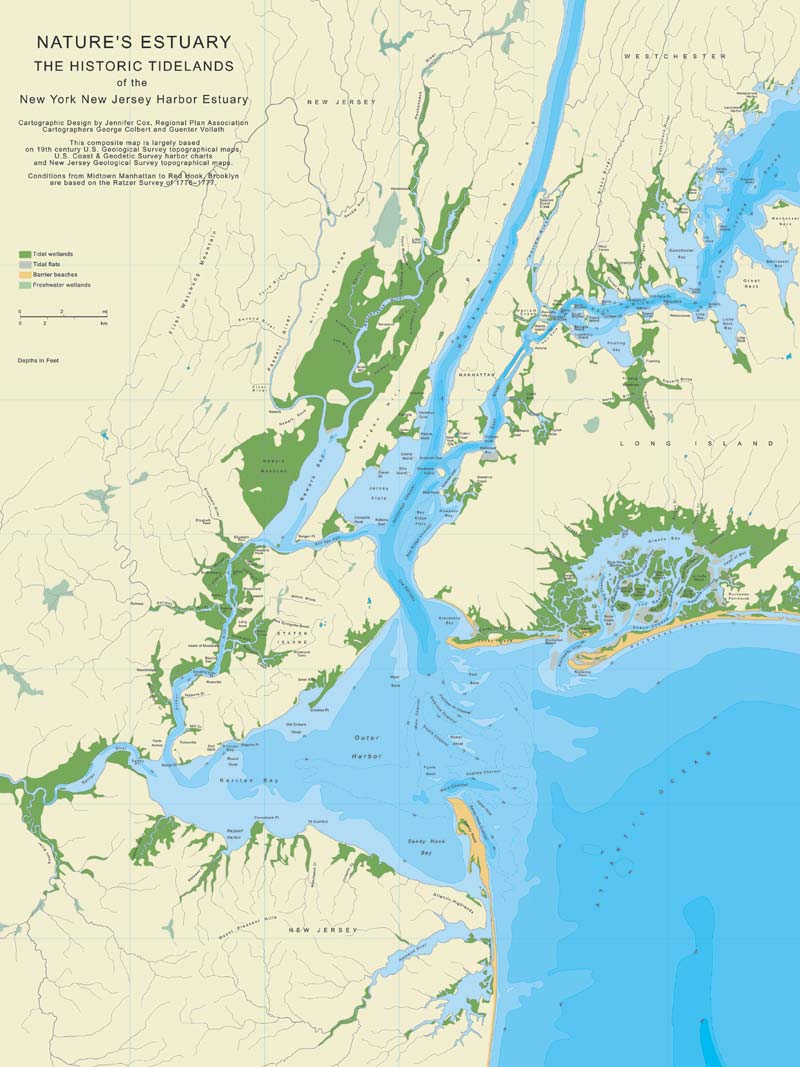
Our estuary is suffering great losses. In the past century, 85% of the New York and New Jersey area’s saltwater wetlands were destroyed by development and pollution. In 2012, the municipal government released its Wetlands Strategy as part of PlaNYC. The document also provides an excellent overview Independent nonprofits like the American Littoral Society, Regional Plan Association, and Riverkeeper, as well as state and federal initiatives like the Harbor-Estuary Program, have long advocated for protection and restoration through smarter growth and replanting.

HarborLAB Founder and Executive Director Erik Baard took the crisis as an opportunity for service learning across the city. He conceived “Cordgrass in the Classroom.” This distributed program, if fully realized, would affordably empower educators and students to improve our environment in a way that might integrate in standard curricula. Many thanks to the Greenbelt Native Plant Center and Murfie, a tech startup that digitizes and streams personal CD and vinyl music collections, for making this project possible. Expert consultants from Louisiana State University have also helped greatly.

A building block species for ecosystems in our bays and inlets is spartina, commonly known as cordgrass. Both names, ancient Greek and English, refer to how this marsh grass was used to make rope in olden times. Its greater value, however, is how it stabilizes shorelines with complex rhizomatic root systems. A dense area of cordgrass is called a “baffle,” and it collects silts and organic matter like an upside broom. This builds up to a rich, mucky more terrestrial habitat for invertebrates, other plants and fungi, and the shorebirds and mammals that eat them. Without cordgrass, you won’t see herons and egrets, and water erosion will strip coastal communities of storm protection.

Cordgrass in the Classroom takes inspiration from earlier successes like Trout in the Classroom, MillionTreesNYC, and the Billion Oyster Project. Erik introduced the program at the Steinway Branch branch of the Queens Library as part of Greening Queens Libraries initiative of the North Star Fund. Here’s how it went:

1) A dozen kids and six adults gathered in the library’s community room. They received New York-New Jersey Harbor Estuary Program posters of estuary life. Each participant was asked to name a living thing depicted in the poster until one teen said, “Grass.” The exercise highlighted how we easily overlook the organism that occupies the most space in the landscape and upon which the others depend.

2) A second page depicting wetlands let us discuss what an estuary saltwater wetlands is, as opposed to a beach or a freshwater swamp. We discussed how the complex root systems hold sand and silt together while the upper grasses feed butterfly larvae, provide shelter from predators, and are home to many creatures.

3) Modifying an idea from the Community Science Workshop Network, Erik taught the kids how to make mini-greenhouses from used CD cases donated by Murfie. Another option for local supplies for those not in a rush is NYC WasteMatch. This is a great opportunity to discuss recycling, the plaque of plastics, and how evolution is a constantly-adapting technology that doesn’t become obsolete. That said, even nature can overuse a technology to its near self-destruction; consider how the lignin that made trees possible may have later also overfed  microbes that excreted wastes that nearly smothered our world hundreds of millions of years ago.

Community Science Workshop Network (http://cswnetwork.org)

10253986_10152461243809878_7976149255700978969_n


10271500_10152461245114878_4288370042544891878_n

4) The Greenbelt Native Plant Center kindly supplied guidance along with sand and seeds in brine. Many thanks to HarborLAB Operations Manager Patricia Erickson for driving. At the library, the kids mixed sand, seeds (gathered from the wild), and water. They then smoothed that mixed into CD cases and shut them. When tilted toward the sun and sitting and sitting in a shallow layer of water, the seeds will germinate and blades will shoot upward. Thanks to the CD’s thinness, kids will watch the roots and shoots in a cross-section, much like an ant farm.

5) When the grass outgrows its CD case, it will be transplanted in bunches into small, biodegradable (wood fiber, peat blend) seedling pots, covering their root crowns. When the grass seedlings reach 6′-8″ high, they’ll be ready for transplantation into nature. Among possible sites are HarborLAB’s launch or Jamaica Bay. At our site, we might fill jute rice bags from Jackson Heights will sand and slash them to receive transplants. That, along with stones, might protect the new colony from being washed away by barge wakes.

A girl draws roots onto a CD case greenhouse schematic. Photo by Erik Baard.

A girl draws roots onto a CD case greenhouse schematic. Photo by Erik Baard.

For those wanting to create more ambitious CD case greenhouses, Erik built the one below in five minutes using clear tape. It can be built taller to protect more mature plants. Like the simpler form, there’s adequate ventilation.

Cubed CD case mini-greenhouse. Photo by Erik Baard.

Cubed CD case mini-greenhouse. Photo by Erik Baard.

Some have gone hog wild with CD case greenhouses. For walk-in sized greenhouses made of reused plastics, many opt for discarded bottles.