
Spartina nursery at the Greenhouse at the Greenbelt Native Plant Center on Staten Island. Photo by Erik Baard.
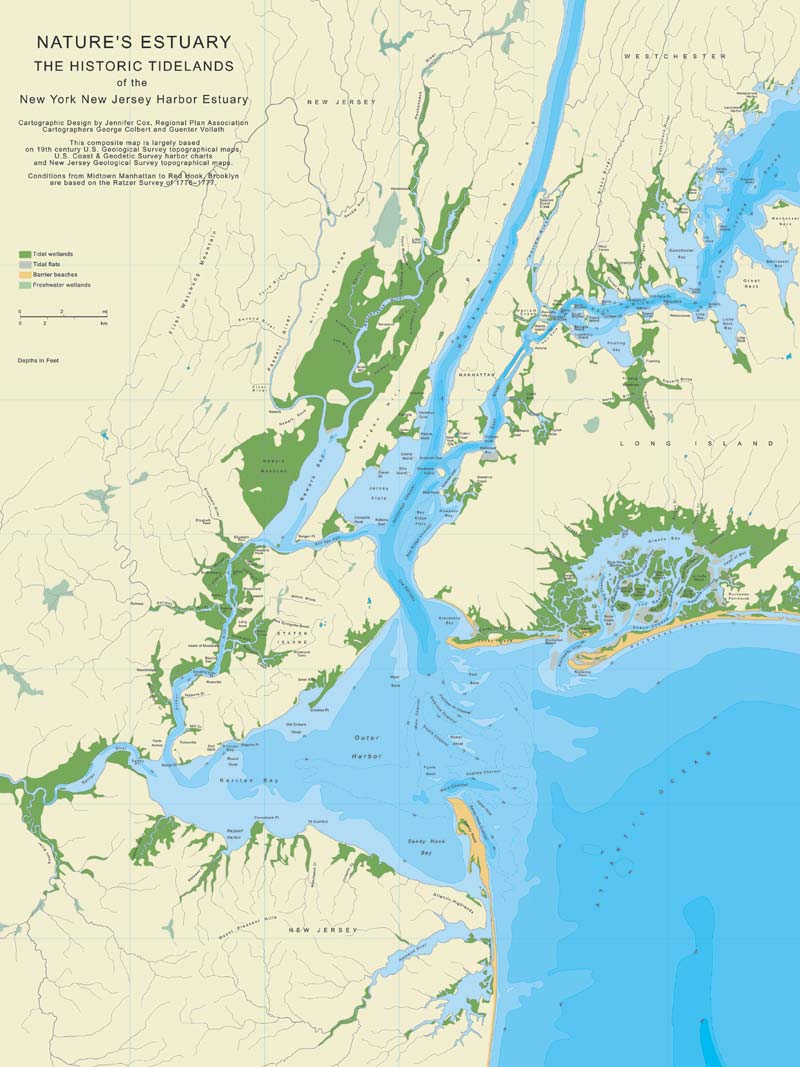
Our estuary is suffering great losses. In the past century, 85% of the New York and New Jersey area’s saltwater wetlands were destroyed by development and pollution. In 2012, the municipal government released its Wetlands Strategy as part of PlaNYC. The document also provides an excellent overview Independent nonprofits like the American Littoral Society, Regional Plan Association, and Riverkeeper, as well as state and federal initiatives like the Harbor-Estuary Program, have long advocated for protection and restoration through smarter growth and replanting.
HarborLAB Founder and Executive Director Erik Baard took the crisis as an opportunity for service learning across the city. He conceived “Cordgrass in the Classroom.” This distributed program, if fully realized, would affordably empower educators and students to improve our environment in a way that might integrate in standard curricula. Many thanks to the Greenbelt Native Plant Center and Murfie, a tech startup that digitizes and streams personal CD and vinyl music collections, for making this project possible. Expert consultants from Louisiana State University have also helped greatly.
A building block species for ecosystems in our bays and inlets is spartina, commonly known as cordgrass. Both names, ancient Greek and English, refer to how this marsh grass was used to make rope in olden times. Its greater value, however, is how it stabilizes shorelines with complex rhizomatic root systems. A dense area of cordgrass is called a “baffle,” and it collects silts and organic matter like an upside broom. This builds up to a rich, mucky more terrestrial habitat for invertebrates, other plants and fungi, and the shorebirds and mammals that eat them. Without cordgrass, you won’t see herons and egrets, and water erosion will strip coastal communities of storm protection.
Cordgrass in the Classroom takes inspiration from earlier successes like Trout in the Classroom, MillionTreesNYC, and the Billion Oyster Project. Erik introduced the program at the Steinway Branch branch of the Queens Library as part of Greening Queens Libraries initiative of the North Star Fund. Here’s how it went:
1) A dozen kids and six adults gathered in the library’s community room. They received New York-New Jersey Harbor Estuary Program posters of estuary life. Each participant was asked to name a living thing depicted in the poster until one teen said, “Grass.” The exercise highlighted how we easily overlook the organism that occupies the most space in the landscape and upon which the others depend.
2) A second page depicting wetlands let us discuss what an estuary saltwater wetlands is, as opposed to a beach or a freshwater swamp. We discussed how the complex root systems hold sand and silt together while the upper grasses feed butterfly larvae, provide shelter from predators, and are home to many creatures.
3) Modifying an idea from the Community Science Workshop Network, Erik taught the kids how to make mini-greenhouses from used CD cases donated by Murfie. Another option for local supplies for those not in a rush is NYC WasteMatch. This is a great opportunity to discuss recycling, the plaque of plastics, and how evolution is a constantly-adapting technology that doesn’t become obsolete. That said, even nature can overuse a technology to its near self-destruction; consider how the lignin that made trees possible may have later also overfed microbes that excreted wastes that nearly smothered our world hundreds of millions of years ago.


4) The Greenbelt Native Plant Center kindly supplied guidance along with sand and seeds in brine. Many thanks to HarborLAB Operations Manager Patricia Erickson for driving. At the library, the kids mixed sand, seeds (gathered from the wild), and water. They then smoothed that mixed into CD cases and shut them. When tilted toward the sun and sitting and sitting in a shallow layer of water, the seeds will germinate and blades will shoot upward. Thanks to the CD’s thinness, kids will watch the roots and shoots in a cross-section, much like an ant farm.
5) When the grass outgrows its CD case, it will be transplanted in bunches into small, biodegradable (wood fiber, peat blend) seedling pots, covering their root crowns. When the grass seedlings reach 6′-8″ high, they’ll be ready for transplantation into nature. Among possible sites are HarborLAB’s launch or Jamaica Bay. At our site, we might fill jute rice bags from Jackson Heights will sand and slash them to receive transplants. That, along with stones, might protect the new colony from being washed away by barge wakes.

A girl draws roots onto a CD case greenhouse schematic. Photo by Erik Baard.
For those wanting to create more ambitious CD case greenhouses, Erik built the one below in five minutes using clear tape. It can be built taller to protect more mature plants. Like the simpler form, there’s adequate ventilation.

Cubed CD case mini-greenhouse. Photo by Erik Baard.
Some have gone hog wild with CD case greenhouses. For walk-in sized greenhouses made of reused plastics, many opt for discarded bottles.


You must be logged in to post a comment.