June 1 Jamaica Bay Marsh Restoration!

IMG_6717

(Aerial photo of planting site by Public Lab and Louisiana-based Dredge Research Collaborative. Expand to see rows of seedlings)

10371387_10152523365481018_8032685643094581245_n

American Littoral Society, Google, Citizens Committee for NYC, and HarborLAB celebrate a great day of planting spartina to restore Jamaica Bay. Great job, HarborLAB Operations Manager EJ Lee and many thanks to our partners!

On Sunday, June 1, HarborLAB brought Citizens Committee for NYC and Google to paddle and help the American Littoral Society and Jamaica Bay EcoWatchers plant spartina marsh grass, a building block of our estuary ecosystem. We were thrilled to work beside Audubon volunteers and others, and to learn more about restoring vital saltwater marsh habitat. Many thanks to American Littoral Society Northeast President Don Riepe, who organized the full event, and Lori Lichtman, Development and Volunteer Coordinator for Citizens Committee for NYC!

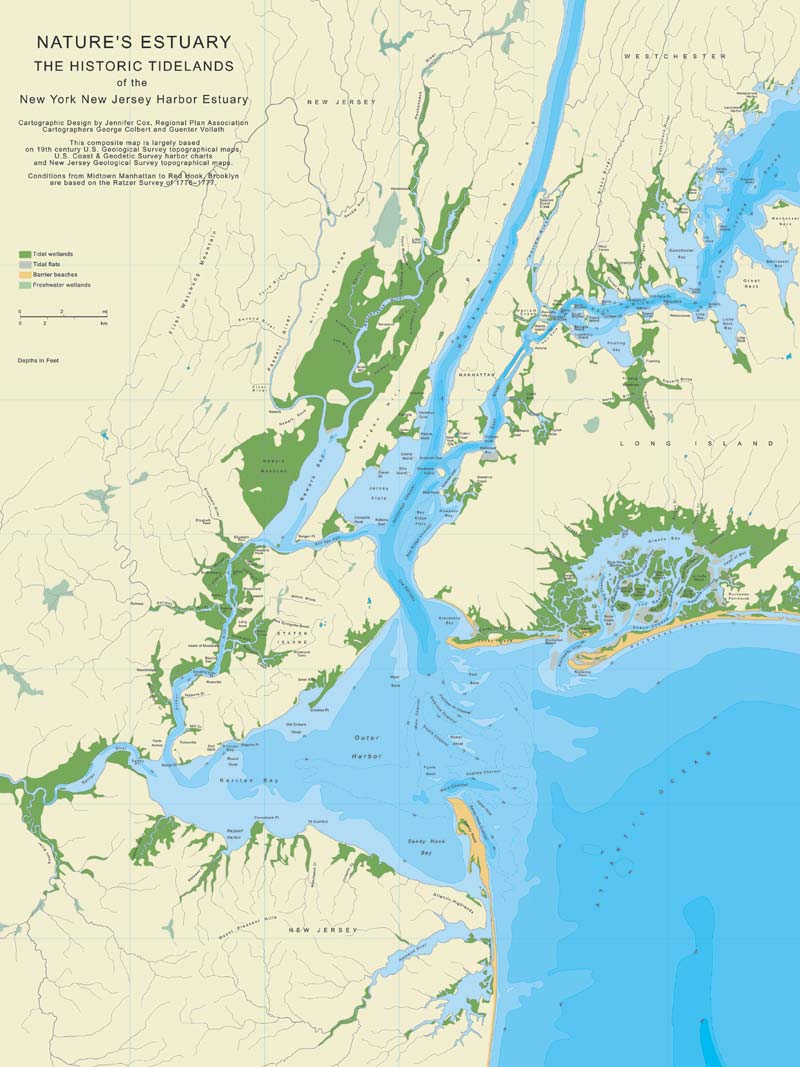
Over the past century our region’s saltwater marsh grass areas have been reduced by 85% due to development, pollution, and other urban pressures. HarborLAB started “Cordgrass in the Classroom” to help students understand this problem and participate in its solution. Now we are combining planting and paddling into event days that augment the efforts of those leading the challenging work of restoration. The Google gaggle took turns planting thousands of seedlings and kayaking around areas where they could see mature plants supporting shorebirds, invertebrates, and marine life. It was fun to introduce Google employees and interns to this work, and to deepen our relationship with Citizens Committee for NYC. Thanks in great part to Citizens Committee for NYC, we will soon plant spartina and other native species at our launch site on the Newtown Creek!

This event was an achievement for HarborLAB because despite being a small and young organization, we produced two simultaneous programs on June 1, this marsh grass restoration and nature paddles by canoe on Willow Lake in Flushing Meadows-Corona Park. HarborLAB Operations Manager EJ Lee was our on-site leader at Jamaica Bay and Executive Director Erik Baard made the arrangements for both events while leading on-site at Willow Lake.

All photos in the gallery are by American Littoral Society and Citizens Committee for NYC.

June 7 Saturday Science Stumper!

Horseshoe Ctab Blood

SATURDAY SCIENCE STUMPER from HaborLAB!

What is this profoundly ancient, living and life-saving substance from the sea, bottled by science? Hint: It’s at your nearby hospital and coming ashore right now…

10351831_695210203872715_7939294975126330775_n
ANSWER TO LAST WEEK’S SATURDAY SCIENCE STUMPER:

While the New York Wheel will be a wonder to paddle beneath, Baltimore paddlers might be more grateful for their solar-powered wheel, which removes tons of garbage from the water daily! More here:http://gizmodo.com/baltimores-solar-wheel-pulls-in-25-tons-of-harbor-garba-1578474782

Newtown Creek Canoe Flags!


WP_20140518_039

The Bernie Entie flies its flag at the Newtown Creek Nature Walk steps.


HarborLAB now flies flags from its canoes bearing names that honor environmentalists who went before us and the species that share our estuary. We’re grateful to artist and graphic designer Caroline Walker for leading this effort and to Algonquin scholar Evan Pritchard for offering a traditional blessing of our boats and flags. Thanks also to HarborLAB Operations Manager for helping to make this all possible!

WP_20140518_022

Newtown Creek Alliance Interim Chair Dorothy Morehead holds HarborLAB’s canoes for a blessing with burning sage given by Evan Pritchard of the Center for Algonquin Culture.


WP_20140518_023

Paddlers holding our flag for The River Singer, which honors Pete Seeger. The art and writing were done for HarborLAB by Pete Seeger himself.

THE RIVER SINGER:  Pete Seeger pioneered the great Hudson River revival by building the Clearwater, a sloop that sails that river up and down to sing up its restoration and carry educators and scientific equipment. When HarborLAB Founder Erik Baard was working with Pete Seeger on a project to promote estuary education, he declined to have a boat named for himself. Instead, he drew a fish exclaiming, “Keep my waters clean!” Friends at the NYC Friends of Clearwater confirmed that humility should carry forward after Pete’s passing. The charming drawing has become our flag for The River Singer. named for Pete’s description of himself.

CARSON_THUMB

The “oceanic egg” flag honoring Rachel Carson. By Tracy Coon, artist, and Caroline Walker, art director.

THE RACHEL CARSON: Rachel Carson sparked the modern American environmental movement with her breakthrough book, “Silent Spring.” Her work expanded our conception of environmentalism beyond conservation of wilderness to demanding corporate and governmental responsibility for pollution. She sounded the alarm about promiscuous DDT spraying that was weakening wild birds’ egg shells, causing population collapses. Many forget that she was a career marine biologist, working for the federal government. Erik Baard imagined an “oceanic egg” to represent Carson, capturing her marine biology and DDT work, and reminding viewers that today’s oceans are as fragile as eggs in comparison to pollution from plastics, fertilizer runoffs, and CO2 emissions that become carbonic acid in the sea around us. Tracy Coon made that abstract idea elegantly real.

jenny_thumb(1) (1)

Flag honoring environmental filmmaker Jenni Jenkins. By Caroline Walker and Erik Baard.

THE JENNI “APPLESEED” JENKINS:  When we honor Jenni, we honor a wonderful light snuffed our too early and all of the students at her alma mater, City University of New York. Jenni loved Newtown Pippin apples (painted here by Erik Baard) and served as videographer for a fascinating day paddling on the Newtown Creek and East River with environmental leader and author Bill McKibben of 350.org and Middlebury College. On that outing were journalist and HarborLAB volunteer Davis Janowski and Erik Baard.

Please enjoy the beautiful film, “Plastic Bag,” co-written by Jenni and narrated by (believe it or not) Werner Herzog!

BER_THUMB

Flag honoring photographer and Newtown Creek Alliance board member Bernie Ente. By Caroline Walker, inspired by an Ente photograph.

THE BERNIE ENTE:  In much the same way that Pete Seeger sang the public into awareness about the Hudson River’s urgent needs, photographer Bernie Ente documented life and struggle in the Newtown Creek. Birds, fish, flowers, and other beauties of nature eked out a living on the creek, without being seen or celebrated. Without care. We’re grateful to Bernie for helping us see the Newtown Creek as a place of life and hope. This flag by Caroline Walker was inspired by Bernie’s striking photo of a green heron and discarded balloons on the Newtown Creek. When we honor Bernie, we also honor the Newtown Creek Alliance and Working Harbor Committee.

Newtown Creek green heron by Bernie Ente.


muskrat

The Muskrat Love flag by Caroline Walker.

THE MUSKRAT LOVE: Caroline Walker brought playfulness to our flags with “The Muskrat Love.” HarborLAB volunteers saw a muskrat swim past our boat launch. Erik Baard’s photo was the first documentation of the species in Newtown Creek. On a later outing Newtown Creek Alliance interim Chair Dorothy Morehead spotted paw prints that Erik recognized as muskrat tracks. If HarborLAB has an unofficial Newtown Creek mascot, this is it. Fittingly, Caroline’s flag matches what might be America’s most polluted waterway with what might be America’s worst love song!

Prof. Pritchard noted, however, that the muskrat plays an heroic role in Algonquin creation beliefs. The brave little mammal swam to the bottom of the water to scoop up soil to place on the turtle’s back. It grew to form North America, but our mythical friend didn’t survive the ordeal. Let’s hope the Newtown Creek muskrats have a brighter future.

THE MOO XOOL:  This is the local Algonquin word for both the tulip tree and a dugout canoe carved from the tulip tree. Will you be the artist for it? We have ideas for a design but would love to hear from you! Email harborlab@gmail.com with the subject “moo xool” if you’d like to work on our flag!


Cordgrass in the Classroom

10277811_10152460397609878_535280063104689233_n

Spartina nursery at the Greenhouse at the Greenbelt Native Plant Center on Staten Island. Photo by Erik Baard.

Our estuary is suffering great losses. In the past century, 85% of the New York and New Jersey area’s saltwater wetlands were destroyed by development and pollution. In 2012, the municipal government released its Wetlands Strategy as part of PlaNYC. The document also provides an excellent overview Independent nonprofits like the American Littoral Society, Regional Plan Association, and Riverkeeper, as well as state and federal initiatives like the Harbor-Estuary Program, have long advocated for protection and restoration through smarter growth and replanting.

HarborLAB Founder and Executive Director Erik Baard took the crisis as an opportunity for service learning across the city. He conceived “Cordgrass in the Classroom.” This distributed program, if fully realized, would affordably empower educators and students to improve our environment in a way that might integrate in standard curricula. Many thanks to the Greenbelt Native Plant Center and Murfie, a tech startup that digitizes and streams personal CD and vinyl music collections, for making this project possible. Expert consultants from Louisiana State University have also helped greatly.

A building block species for ecosystems in our bays and inlets is spartina, commonly known as cordgrass. Both names, ancient Greek and English, refer to how this marsh grass was used to make rope in olden times. Its greater value, however, is how it stabilizes shorelines with complex rhizomatic root systems. A dense area of cordgrass is called a “baffle,” and it collects silts and organic matter like an upside broom. This builds up to a rich, mucky more terrestrial habitat for invertebrates, other plants and fungi, and the shorebirds and mammals that eat them. Without cordgrass, you won’t see herons and egrets, and water erosion will strip coastal communities of storm protection.

Cordgrass in the Classroom takes inspiration from earlier successes like Trout in the Classroom, MillionTreesNYC, and the Billion Oyster Project. Erik introduced the program at the Steinway Branch branch of the Queens Library as part of Greening Queens Libraries initiative of the North Star Fund. Here’s how it went:

1) A dozen kids and six adults gathered in the library’s community room. They received New York-New Jersey Harbor Estuary Program posters of estuary life. Each participant was asked to name a living thing depicted in the poster until one teen said, “Grass.” The exercise highlighted how we easily overlook the organism that occupies the most space in the landscape and upon which the others depend.

2) A second page depicting wetlands let us discuss what an estuary saltwater wetlands is, as opposed to a beach or a freshwater swamp. We discussed how the complex root systems hold sand and silt together while the upper grasses feed butterfly larvae, provide shelter from predators, and are home to many creatures.

3) Modifying an idea from the Community Science Workshop Network, Erik taught the kids how to make mini-greenhouses from used CD cases donated by Murfie. Another option for local supplies for those not in a rush is NYC WasteMatch. This is a great opportunity to discuss recycling, the plaque of plastics, and how evolution is a constantly-adapting technology that doesn’t become obsolete. That said, even nature can overuse a technology to its near self-destruction; consider how the lignin that made trees possible may have later also overfed  microbes that excreted wastes that nearly smothered our world hundreds of millions of years ago.

Community Science Workshop Network (http://cswnetwork.org)

10253986_10152461243809878_7976149255700978969_n


10271500_10152461245114878_4288370042544891878_n

4) The Greenbelt Native Plant Center kindly supplied guidance along with sand and seeds in brine. Many thanks to HarborLAB Operations Manager Patricia Erickson for driving. At the library, the kids mixed sand, seeds (gathered from the wild), and water. They then smoothed that mixed into CD cases and shut them. When tilted toward the sun and sitting and sitting in a shallow layer of water, the seeds will germinate and blades will shoot upward. Thanks to the CD’s thinness, kids will watch the roots and shoots in a cross-section, much like an ant farm.

5) When the grass outgrows its CD case, it will be transplanted in bunches into small, biodegradable (wood fiber, peat blend) seedling pots, covering their root crowns. When the grass seedlings reach 6′-8″ high, they’ll be ready for transplantation into nature. Among possible sites are HarborLAB’s launch or Jamaica Bay. At our site, we might fill jute rice bags from Jackson Heights will sand and slash them to receive transplants. That, along with stones, might protect the new colony from being washed away by barge wakes.

A girl draws roots onto a CD case greenhouse schematic. Photo by Erik Baard.

A girl draws roots onto a CD case greenhouse schematic. Photo by Erik Baard.

For those wanting to create more ambitious CD case greenhouses, Erik built the one below in five minutes using clear tape. It can be built taller to protect more mature plants. Like the simpler form, there’s adequate ventilation.

Cubed CD case mini-greenhouse. Photo by Erik Baard.

Cubed CD case mini-greenhouse. Photo by Erik Baard.

Some have gone hog wild with CD case greenhouses. For walk-in sized greenhouses made of reused plastics, many opt for discarded bottles.