What is this profoundly ancient, living and life-saving substance from the sea, bottled by science? Hint: It’s at your nearby hospital and coming ashore right now…
HarborLAB launch (beige building to the right) on the Newtown Creek from the Pulaski Bridge. The East River and its branches, like the creek, are saltier and so don’t freeze as easily, but perhaps the creek’s water treatment plant’s outflows and street runoffs are freezing? Photo by Steve Scofield of the Transportation Alternatives Queens Activist Committee (http://transalt.org/getinvolved/neighborhood/queens).
1867 etching of a flow of humanity across the frozen East River. One of eight times the strait froze over during that century. Image via Gothamist (click for link).
Ice floes on the East River are a rare sight in recent years, but the Brooklyn Bridge is a daily reminder of how extreme even relatively recent planetary climate fluctuations have been. Let’s explore how that is so, and take a fun detour into the molecular structure of water.
When scientists worry about climate change and global warming, they’re not ignoring the fact that Earth has experienced wildly different atmospheric compositions and temperatures over its 3.8 billion years as a living world. What we’re destabilizing, they worry, are the conditions that for 12,000 years have fostered the neolithic agricultural revolution and civilization itself.
Some worry that the more energy retained by the atmospheric system (global warming) through higher CO2 concentrations, the more chaotic it might become in mid-latitude coastal areas (our temperate zone) as we become a pass-through for storms that transport energy between the tropics and arctic. But just as a cold snap in one region or continent doesn’t refute the mounting evidence of global warming, it can be argued that we can’t say with certainty that storms like Hurricane Sandy are the result of warming.
That said, there are records, written and archeological, of worldwide changes that lasted years or even centuries. Might we enter another “Little Ice Age” like that of roughly 1300-1870? To get an idea of how severe winters of that period could be, several times the East River froze over. Brave souls walked over “ice bridges” from Brooklyn to Manhattan, but ferries vital to commerce were locked in place. After this happened again in the winter of 1866-67, businesses in our growing metropolis had enough and lobbied hard for a long-contemplated “Great East River Bridge” to keep commerce flowing in all weather. As it happens, the Brooklyn Bridge was completed in 1883, eight years after the East River last froze over solid. In a sense, the Brooklyn Bridge touches down on the shores of two boroughs and on the shores of two climatic ages. And we might have a Brooklyn Bridge because the Sun lacked spots!
A few things can cause the planet to cool. Some ascribe the deepest points of the Little Ice Age to the Maunder Minimum, a period sunspots and solar flares were extremely rare. Our sun is in a lull right now, but a 2012 NASA study found that recent solar inactivity hasn’t impacted our planet’s “energy budget” much. A 2013 study by researchers with the National Center for Atmospheric Research (part of the National Science Foundation) and partners concluded that a Maunder Minimum redux wouldn’t save us from global warming.
Just as adding carbon dioxide, water vapor, and methane to the atmosphere can warm the planet, kicking up dust and soot can cool it. Volcanoes have caused global cooling, as perhaps have asteroids and comets (even beloved Halley’s Comet). Some people even advocate for “geoengineering” projects that would cool the planet, but implementation could bring their own disasters. Besides, Ocean acidification, which could collapse the planetary ecosystem, would proceed apace if we continue to burn fossil fuels, even if we dust up to cool down.
East River ice floes and Hunter’s Point South (and the ice-whitened mouth of the Newtown Creek). Photo by Mark Christie of Friends of Gantry and Neighborhood Parks (http://friendsofgantry.org/).
East River ice floes floating past Gantry Plaza State Park in Long Island City, Queens. Photo by Mark Christie of Friends of Gantry and Neighborhood Parks (http://friendsofgantry.org/).
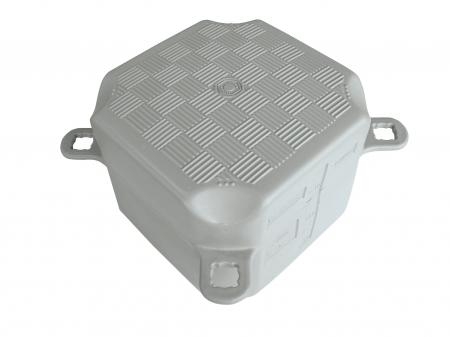
Candock floating a car. Yeah, it can handle our kayaks. 🙂
Our plans for purchasing a used dock from the Yonkers Paddling and Rowing Club chanced on a sprinkling of Murphy’s Law: donations to our 501(c)(3) fiscal sponsor (Earth Day New York) were returned because of an address change. During that delay while they were being mailed again, the old dock was sold instead to the LIC Community Boathouse (a group founded earlier by Erik Baard, HarborLAB’s founder). May it be used safely and happily by adults recreating there.
HarborLAB will instead purchase a modern, modular Candock with a recent sponsorship from TF Cornerstone, which is developing part of the LIC waterfront. Thank you TF Cornerstone! We look forward to launching exciting educational tours, filled with residents and especially CUNY students, from our Hunters Point South district dock in May.
Volunteers who became among the first to grow HarborLAB previously assembled this kind of modular dock at Governors Island two years ago, in preparation for City of Water Day. It’s durable, easy to assemble, and safe. Our plan is to start small, at 8′ by 14’3″, with an additional stabilizing perimeter. This is adequate for our relatively small throughput of paddlers (typically groups of fewer than 20, with only three people on a dock at once) and we can add modules as HarborLAB grows!
Muskrat swimming against the tide and toward the white late afternoon sun trail, past the HarborLAB launch. Photo by Erik Baard.
After a long day of producing a public paddle event at Flushing Meadows-Corona Park, HarborLAB volunteers were treated to the sight of a new (or at least newly sighted) neighbor at our Newtown Creek launch. A muskrat!
We believe this creature hasn’t been verifiably reported in the Newtown Creek in living memory. The Newtown Creek’s chief chronicler and photographer, Mitch Waxman, says there have been murmurs about it for over a year.
For urbanites like us, a muskrat conjures images of fur trappers and musk collectors from centuries past. This indigenous, semi-aquatic burrowing rodent is ubiquitous over much of North America. Indeed, Algonquin and other Native American creation stories credit the muskrat with swimming to the primordial ocean floor to scoop up the mud that formed the lands of the world. This animal is also depicted as the mother of humanity in some tales, and often as an auspicious symbol promising wealth. Perhaps HarborLAB has found a mascot?
Surprised to see this critter in the Newtown Creek? We were too, but perhaps we shouldn’t have been; muskrats survive in sulfurous streams polluted by coal plants, where frogs and fish have been wiped out. These herbivores (they’ll only occasionally eat small amphibians, invertebrates, and shellfish) thrive in wetlands, but have found niches in more challenging areas disrupted by development. One benefit of muskrats is that they eat invasive phragmites reeds, which choke out native plants in fresh and brackish waters. The fate of muskrats (locally breeding or arriving) factored into a National Oceanic and Atmospheric Administration study on the possible scope of industrial damage to the Newtown Creek’s natural resources. No doubt many muskrats once inhabited this waterway, but not in living memory. A study for the Environmental Protection Agency done by HarborLAB sponsor AECOM posited that muskrats might use the creek:
“Birds are likely to be the principal aquatic-dependent wildlife species that occur in and around the Study Area, although some mammals such as muskrats may use the area. Members of various avian feeding guilds may, at one time or another, also be present in the Study Area.” — Remedial Investigation/Feasibility Study Work Plan Newtown Creek (AECOM Environment)
This muskrat might be living in a burrow dug into the soft slope where the bulkhead has disintegrated on the Queens side of the Newtown Creek. Muskrats are usually nocturnal or crepuscular, so they’re not easy to spot. We have few muskrat predators here, though these rodents (especially their young) might still find themselves on the menu for cats, raptors, some large fish, and turtles.
Muskrats prefer slow-moving waterways, but can transit on swifter courses like the East River. They aren’t likely to drown in strong currents because they can hold their breath for up to 17 minutes!
We’re not sure what this neighbor was up to. It swam against a mild but burgeoning flood tidal current, using its distinctive vertically-flat tail as a flagellum to propel it toward the white sun trail of late afternoon. Its partially webbed hind feet are a secondary means of swimming. What we do know is that it looked so serious about its agenda, which made it look even more painfully cute.
“It’s serious stuff, being an urban muskrat,” remarked Waxman.
It may have been seeking new territory, for mating advantage or because it belonged to a population that had consumed its food sources. Muskrat populations often boom and bust with available edible plants. Sadly, most muskrats don’t live more than a year.
Where we are, toward the Newtown Creek mouth, water quality is better than inland reaches. This is because ocean water flowing through the East River strait swirls into the creek west of the Pulaski Bridge. Dissolved oxygen levels are higher than the creek average, allowing for more fish and invertebrates and therefore a heartier ecosystem. Also, we’ve had a dry spell, so pipes combining storm water with household sewage haven’t overflowed into the creek recently. That said, however, the sediment pollutants that warrant U.S. Environmental Protection Agency Superfund designation remain a carcinogenic hazard for mammals feeding in the creek or having repeated exposure. Muskrats have been shown to concentrate, or bioaccumulate, metals in their tissues.
As for protecting the human mammal, HarborLAB uses canoes on the creek to reduce water contact greatly. Our sit-on-top kayaks are exclusively for harbor voyages. We never have children paddle from the Newtown Creek site or contaminated nearby sites like Anable Basin and Hallets Cove. We make the effort to host children’s paddling in cleaner regional waters, while advocating for local cleanups.
HarborLAB hopes this little guy finds a healthier habitat to call home soon. But for one afternoon, we enjoyed “Muskrat Love.”



You must be logged in to post a comment.